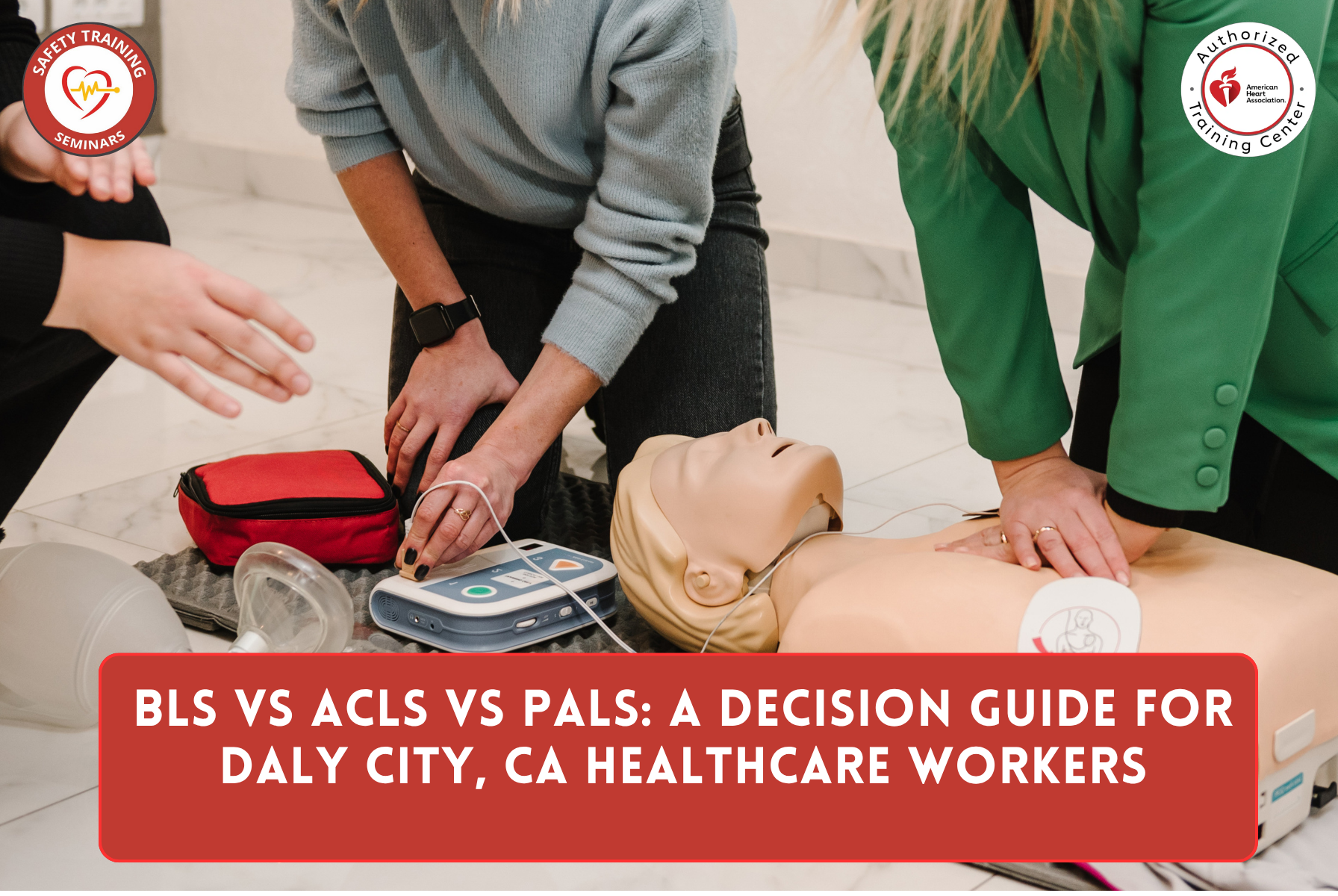
Healthcare workers in Daly City may see BLS, ACLS, and PALS listed together, but the courses serve different purposes. For many healthcare roles, a BLS CPR certification course is the foundation. ACLS adds advanced adult cardiovascular emergency care, while PALS focuses on seriously ill or injured infants and children.
The right choice depends on your job duties, patient population, and the exact requirement from your employer, school, or clinical program. If you are enrolling for a new position, clinical rotation, or renewal, use the credential name on your paperwork rather than simply choosing the most advanced-sounding course.
Key Takeaway: BLS covers core healthcare resuscitation skills. ACLS builds on BLS for advanced adult emergencies, while PALS applies advanced resuscitation principles to pediatric patients. Confirm the exact credential required before registering.
Start With Your Role and Patient Population
A practical way to compare the three courses is to ask two questions: Who do you care for, and what is your responsibility during a resuscitation?
BLS focuses on foundational skills such as high-quality CPR, ventilation, and AED use. The American Heart Association describes its BLS Provider Course as designed for healthcare professionals, trained first responders, and people enrolled in healthcare training programs.
ACLS builds on those BLS skills for adult cardiac arrest and other serious cardiopulmonary emergencies, with added emphasis on coordinated team response and advanced intervention.
PALS is centered on pediatric emergencies. It prepares healthcare professionals to assess and respond to problems such as respiratory emergencies, shock, arrhythmias, and cardiopulmonary arrest in children.
That means the correct course is determined by clinical responsibility, not by which credential sounds more advanced.
BLS: The Foundation for Many Healthcare Roles
The word “basic” can be misleading. BLS is not simply a lesser version of ACLS or PALS. It teaches the core resuscitation skills healthcare teams rely on when a patient becomes unresponsive or experiences cardiac arrest.
For nurses, nursing students, dental professionals, medical assistants, first responders, and other healthcare workers, BLS may be the credential specifically requested by an employer or school. The AHA also advises learners to confirm with their employer that they are selecting the correct course.
If your requirement says BLS, do not assume that a general CPR class or an advanced course automatically replaces it. Check the exact course name and issuing organization required by your workplace or program.
Learners who need a local option can review Daly City CPR, BLS, ACLS, and PALS classes and compare the course information with their requirement before registering.
ACLS or PALS? The Difference Comes Down to Clinical Context
ACLS is generally the next consideration for professionals involved in advanced adult cardiovascular care. It builds on BLS and is relevant when a clinician may participate in the recognition and treatment of adult cardiac arrest or other cardiopulmonary emergencies.
PALS shifts the focus to pediatric patients. It is intended for healthcare professionals who may need to recognize and manage serious illness or injury in infants and children.
A simple way to think about the difference is:
- BLS: foundational healthcare CPR, ventilation, and AED skills.
- ACLS: advanced adult cardiovascular emergency care built on BLS.
- PALS: advanced pediatric emergency assessment and resuscitation.
Some professionals may need more than one credential. For example, a provider working with both adult and pediatric patients may be asked for BLS plus ACLS and PALS. Requirements vary by employer and department, so the course combination should come from the organization requesting certification.
Professionals who live or work closer to the coast can also review CPR and advanced life support classes near Half Moon Bay when comparing local options.
Use This Five-Step Check Before Registering
If you are unsure which course belongs on your checklist, use this process:
- Read the requirement exactly. Look for BLS, ACLS, PALS, CPR/AED, or First Aid by name.
- Identify your patient population. Advanced adult care points toward ACLS; pediatric advanced care points toward PALS.
- Separate foundational and advanced credentials. BLS may still be required even when ACLS or PALS is also listed.
- Confirm the accepted course type. Employers, schools, and licensing organizations may specify what they accept.
- Verify before registering. Ask your employer, program coordinator, or clinical educator if the wording is unclear.
This is especially useful for healthcare workers changing departments or students starting a new clinical placement. A credential that met the requirements for one role may not meet the requirements for another.
For learners farther south on the Peninsula, the Hillsborough CPR, BLS, ACLS, and PALS course page provides another nearby location to review.
What Daly City Healthcare Workers Should Confirm Before Class
Local convenience matters, but the correct credential matters more. Before choosing training in Daly City or traveling from Pacifica, San Bruno, Millbrae, Redwood City, or another nearby community, confirm whether you are taking an initial course or renewing an existing credential.
Also check what identification, pre-course work, or documentation may be required for the specific class you select. Those details can vary by course and provider, so use the current registration information rather than relying on assumptions from a previous class.
Healthcare workers who study or work across the Peninsula may find it useful to compare more than one location. The East Palo Alto CPR and healthcare certification course page is one additional option from the supplied locations.
Reviewing Safety Training Seminars Options in Daly City
Safety Training Seminars provides local course information for healthcare professionals and other learners in Daly City. The Daly City training center is listed at 333 Gellert Blvd, Suite 215, Daly City, CA 94015.
If you are deciding between BLS, ACLS, and PALS, review the Daly City course page and compare the available course type with the exact credential named by your employer, school, or clinical program. This is more useful than choosing a class based only on location.
People coming from Pacifica, San Bruno, or nearby Peninsula communities can also compare location pages according to where they live, work, or attend school. The goal is to match the correct certification requirement with a practical training location.
Frequently Asked Questions
Do I need BLS before ACLS?
ACLS builds on BLS skills, but the exact prerequisite and documentation rules can depend on the course and the organization requesting your credential. If your job or program requires ACLS, confirm whether it also expects a current BLS credential before registering.
Is PALS only for pediatric nurses?
No. PALS is intended for healthcare professionals whose responsibilities include managing serious pediatric emergencies, not only nurses with “pediatric” in their title. Your clinical duties and employer requirements are more important than your job title alone.
Which course should a Daly City nursing student take?
Start with the exact requirement provided by your nursing program or clinical placement. BLS may be required for healthcare training programs, while ACLS or PALS can apply to certain clinical roles or placements. If the instructions are unclear, confirm with the program before enrolling.
Can someone from Pacifica or San Bruno take a course in Daly City?
A learner can compare training locations based on travel and scheduling needs, but the course itself still needs to match the credential required by the employer, school, or other organization. Review the Daly City course information before registering.
How long are AHA BLS and ACLS course completion cards valid?
The American Heart Association states that BLS and ACLS course completion cards are valid for two years after successful completion. Employer renewal deadlines or internal policies may differ, so check both your card and your organization’s requirements.
Make the Course Choice From the Requirement, Not the Course Name
For Daly City healthcare workers, the decision is usually straightforward once you separate foundational CPR skills from advanced adult and pediatric care. BLS is the foundation for many healthcare roles, ACLS adds advanced adult cardiovascular emergency management, and PALS focuses on advanced pediatric emergencies.
Your employer, school, licensing board, or clinical program should be the final authority on which credential you need. Safety Training Seminars can be used as a local training option when the available course matches that requirement.
Before registering, review the Daly City course-location page, confirm the exact course name on your paperwork, and check the current registration details. That simple verification can help you choose training that fits both your professional requirement and your location.