Perched at the northern tip of San Mateo County, Daly City occupies a unique position in the Bay Area healthcare landscape. It’s the largest city in San Mateo County, borders San Francisco directly to the south, and serves as a critical transition point for a clinical workforce that moves fluidly across county lines every single day. Nurses finishing evening shifts at Seton Medical Center on Sullivan Avenue, medical technicians commuting to UCSF Medical Center in the city, and emergency responders stationed with the Daly City Fire Department all share one non-negotiable professional requirement: current, valid BLS, ACLS, and PALS training. In a community this dense and this connected to one of the nation’s largest healthcare ecosystems, letting those skills lapse isn’t an option.
The public health stakes are significant. According to the American Heart Association, survival rates for cardiac arrest double or even triple when bystanders deliver prompt CPR before emergency medical services arrive. In a densely populated urban environment like Daly City — where neighborhoods like Westlake, Serramonte, and St. Francis Heights are packed with multi-family housing and a population among the most diverse in California — the proximity between trained responders and people in crisis can genuinely be the difference between life and death. Healthcare professionals in this community carry that weight into every renewal cycle.
What many of those professionals are now realizing is that how they fulfill their BLS, ACLS, or PALS training requirement matters almost as much as the requirement itself. Two distinct pathways exist: the traditional instructor-led classroom model, which has served as the industry standard for decades, and the increasingly adopted Self-Guided Learning™ format paired with CPR Verification Station™ learning centers. This guide compares both honestly, so Daly City’s healthcare workforce can choose the path that actually works for their schedule, their learning style, and their professional obligations.
Overview of CPR Training Options in Daly City
For healthcare professionals across San Mateo County, the two primary options for completing BLS, ACLS, and PALS requirements look like this:
- Instructor-Led Training — A scheduled, in-person classroom session facilitated by a course instructor, where both the cognitive content and hands-on skills practice take place on the same day, typically over four to eight hours depending on the program.
- Self-Guided Learning™ + CPR Verification Stations — A flexible two-part model combining adaptive online coursework completed independently with a focused, technology-driven skills evaluation at a CPR Verification Station™ learning center.
Both formats lead to the same outcome: successfully completing the course and receiving an AHA Course Completion eCard. The experience of getting there, however, is fundamentally different.
Traditional Instructor-Led CPR Training in Daly City
Instructor-led training remains a familiar format for many healthcare teams across Daly City and the broader San Mateo County region. In this setup, participants arrive at a scheduled training facility, join a cohort of fellow learners, and work through AHA-approved curriculum content under the direct guidance of a course instructor. The session typically blends video instruction with hands-on skill rotations, moving from basic concepts into increasingly complex scenarios depending on the program level.
Clinical staff at Kaiser Permanente Daly City Medical Center or healthcare workers commuting between Daly City and South San Francisco for per diem assignments have historically been well-served by group sessions when their employers coordinate them on-site. The model is familiar, socially engaging, and structured — qualities that work well under the right conditions.
How Instructor-Led Training Works
A standard BLS class in Daly City delivered through the instructor-led format typically runs between two and a half and four hours. ACLS courses in Daly city are considerably more demanding, often stretching to a full day when scenario-based components covering advanced rhythm interpretation, pharmacology, and resuscitation team dynamics are factored in. PALS programs follow a similar rhythm, with pediatric-specific assessment and intervention protocols requiring substantial time at each skill station.
Throughout the session, the course instructor observes individual performance, provides real-time coaching, and ultimately confirms when participants have met the AHA’s skills requirements. Once all components are cleared, learners successfully complete the course and receive their AHA Course Completion eCard. The value of direct instructor presence is genuine — particularly for learners encountering advanced material for the first time.
Limitations of Instructor-Led Classes
The model’s weaknesses become apparent quickly for anyone embedded in Daly City’s real-world healthcare environment. Fixed schedules don’t bend for rotating shifts. A critical care nurse at Seton Medical Center coming off a 12-hour overnight run isn’t equipped — cognitively or physically — to absorb six hours of advanced cardiac life support curriculum the next morning. Yet that’s precisely the situation many Daly City healthcare professionals find themselves navigating when renewal deadlines approach.
Geographic friction adds another dimension. Daly City sits at a traffic crossroads where I-280 and US-101 merge with the realities of Bay Area congestion. A 20-minute drive to a training site in San Francisco or South San Francisco can stretch to 45 minutes or more during morning rush hours. For someone already managing a demanding schedule, that lost time compounds the burden of attending a fixed-day classroom program. And when sessions fill — which they do frequently at popular BLS and ACLS locations near major San Francisco Peninsula medical centers — waitlists push already overdue renewals further back, creating real compliance risk.
The Rise of CPR Verification Stations in Daly City
Across the Bay Area, healthcare training has been undergoing a quiet but significant transformation. As the clinical workforce has grown more schedule-diverse — more shift-based, more mobile, more geographically spread across county lines — the demand for flexible training solutions has increased proportionally. CPR Verification Stations have emerged as one of the most meaningful innovations in that shift, replacing subjective instructor observation with objective, sensor-based skills measurement.
Adoption among progressive healthcare organizations in San Mateo County has grown steadily. Training providers serving the Daly City area have seen firsthand how schedule rigidity in the traditional model creates bottlenecks, delays, and frustrated professionals who simply need a more workable path to completing their course requirements.
What Is a CPR Verification Station?
A CPR Verification Station™ learning center is a technology-driven evaluation system built around instrumented manikins embedded with precision sensors. These sensors capture real-time data on every element of CPR performance — compression depth, rate, hand placement, full recoil between compressions, and ventilation timing. The data is processed against AHA performance standards automatically, generating immediate feedback that is objective, consistent, and completely independent of who is observing the session.
For healthcare professionals whose performance in clinical settings is held to exacting, measurable standards, there’s something appropriately rigorous about a skills evaluation that works the same way. The variability inherent in human observation — differences in instructor experience, session size, positioning, or attention — is removed entirely. What remains is a clear, accurate picture of actual performance.
How Self-Guided BLS, ACLS, and PALS Courses Work
The online learning component of the Self-Guided Learning™ model is delivered through the HeartCode® Complete course, the AHA’s approved digital curriculum platform covering BLS, ACLS, and PALS programs. What distinguishes HeartCode® from conventional online video modules is the intelligence embedded in its delivery: True Adaptive™ learning powered by Area9 Lyceum.
This system continuously tracks how each participant engages with content and adjusts the learning experience in real time. An experienced ER nurse from Daly City renewing her ACLS course doesn’t need to sit through the same introductory cardiac rhythm modules as a newly graduated EMT — and with True Adaptive™ learning powered by Area9 Lyceum, she won’t. The platform identifies demonstrated competency and advances accordingly, while identifying genuine gaps and reinforcing those areas before moving forward. The result is a learning experience that’s simultaneously more efficient and more personalized than any group classroom can realistically deliver.
Once the HeartCode® Complete online portion is finished, the participant schedules a brief, targeted skills session at a nearby CPR Verification Station™ location. The hands-on component is focused, time-efficient, and produces an objective confirmation of AHA-standard performance. The AHA Course Completion eCard follows.
Key Advantages of CPR Verification Stations
For healthcare professionals throughout Daly City and neighboring communities like Colma, Pacifica, and South San Francisco, the advantages of this model are tangible and immediate:
- No fixed schedule required — The HeartCode® Complete online course can be started, paused, and resumed around any shift pattern or personal obligation, day or night.
- More efficient use of time — True Adaptive™ learning powered by Area9 Lyceum eliminates redundant review for experienced learners, often cutting total course time meaningfully compared to a full classroom day.
- Standardized, objective skills assessment — CPR Verification Station™ technology measures performance consistently regardless of session timing, group size, or external variables.
- Accessible for San Mateo County professionals — Shorter, more flexible skills sessions are far easier to schedule around a Daly City healthcare professional’s weekly calendar than a full-day classroom block.
Why Healthcare Professionals in Daly City Prefer Self-Guided Learning
Healthcare professionals in the Crocker and Mission Hills neighborhoods of Daly City live at the intersection of one of the Bay Area’s most demanding commuting environments and some of its most rigorous clinical workplaces. The idea of blocking a Saturday for a full ACLS class — when that Saturday might be the only day off in a stretch of six shifts — isn’t a minor inconvenience. It’s a real sacrifice.
Self-Guided Learning™ courses eliminate that tradeoff. A respiratory therapist rotating between Daly City and San Francisco facilities can complete the PALS program online across several evenings at home, in the Serramonte area, or between patient care responsibilities — then book a focused skills session at a nearby CPR Verification Station™ location for the hands-on component. No full-day commitment. No cross-county traffic. No waiting for the next available classroom seat. Just a straightforward, efficient path to successfully completing the course and receiving an AHA Course Completion eCard on a timeline that makes sense.
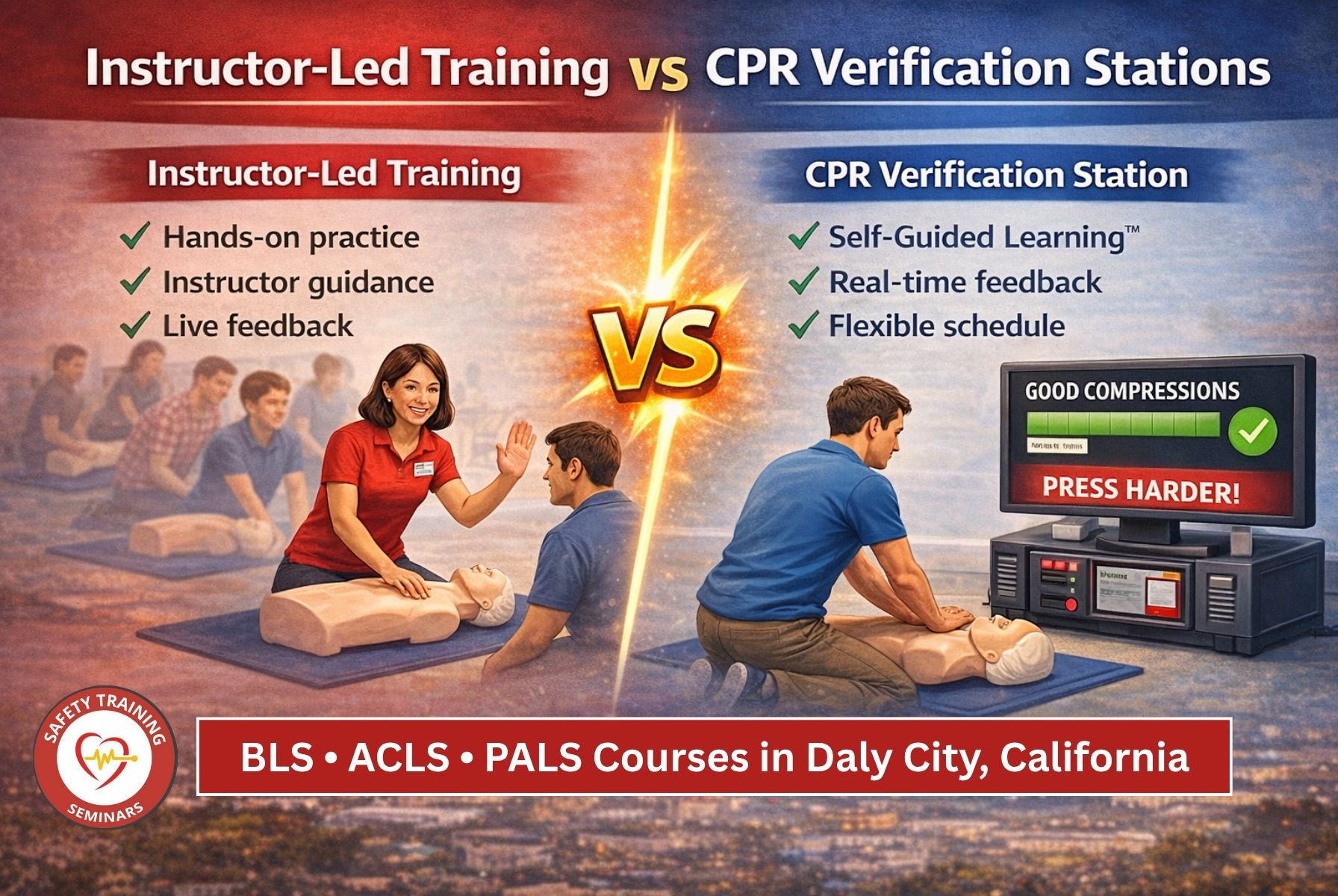
Instructor-Led vs. CPR Verification Stations: Side-by-Side Comparison
Looking at these two formats together, the contrast centers on a fundamental question: who does the training schedule serve? Instructor-led programs are built around the provider’s schedule — a fixed date, a fixed location, a fixed pace that applies equally to everyone in the room regardless of their experience level or prior knowledge. For some learners, that structure is genuinely supportive. For most working clinical professionals in a place like Daly City, it’s an obstacle.
Self-Guided Learning™ with CPR Verification Stations flips that dynamic. The learner controls the pace and timing of the knowledge component through HeartCode® Complete, guided by True Adaptive™ intelligence that matches content to demonstrated understanding. The skills component is brief, focused, and technology-verified — a far cry from the extended, instructor-dependent evaluation of the traditional model. On every dimension that matters practically — flexibility, time efficiency, scheduling accessibility, and consistency of evaluation — the Self-Guided Learning™ model holds a meaningful edge.
Which Option Is Better for You in Daly City?
Instructor-led training is the right choice if you’re completing an ACLS or PALS program for the very first time and value the structure of learning alongside others with a live trainer present. Some participants genuinely benefit from real-time guidance during their initial exposure to complex clinical scenarios, and the group dynamic can reinforce learning through observation and shared discussion.
Self-Guided Learning™ is the stronger fit if you’re renewing familiar material, your schedule doesn’t accommodate fixed classroom commitments, or you need to complete your BLS CPR Course in Daly City, wrap up your ACLS course, or finish your PALS program without sacrificing one of your few days off. For the majority of experienced healthcare professionals in San Mateo County, this is the format that aligns with real life.
Local Demand for CPR BLS, ACLS, and PALS Training in Daly City
Daly City sits at the center of a substantial and growing healthcare workforce. Seton Medical Center on Sullivan Avenue remains a primary regional employer. Kaiser Permanente Daly City Medical Center serves a large patient population and maintains active renewal requirements for its clinical teams. Professionals frequently cross into San Francisco to work at UCSF Medical Center, San Francisco General Hospital (Zuckerberg San Francisco General), and St. Mary’s Medical Center — all of which require current BLS, ACLS, and PALS compliance.
With AHA guidelines requiring renewal every two years and the San Mateo County clinical workforce expanding alongside population growth, the demand for accessible CPR training near Daly City is consistent and substantial. The professionals searching for flexible solutions aren’t looking to cut corners — they’re looking for a model that respects the complexity of their working lives.
How Safety Training Seminars Supports Modern CPR Training
Safety Training Seminars serves healthcare professionals across Daly City, South San Francisco, Colma, Pacifica, and throughout the San Mateo County region with both instructor-led options and the Self-Guided Learning™ model supported by CPR Verification Station™ learning centers. The range of available programs — including BLS, ACLS, PALS, NRP, and First Aid — covers every AHA training need across clinical and non-clinical roles.
What sets the program apart isn’t just the breadth of offerings. It’s the genuine commitment to making high-quality AHA training accessible without the logistical burden that has historically made compliance stressful for busy healthcare professionals. That practical, learner-centered approach has built a strong reputation across the Bay Area.
The Future of CPR Training in Daly City
Healthcare training is moving toward personalization, flexibility, and technology-driven verification — and that shift isn’t slowing down. True Adaptive™ learning powered by Area9 Lyceum and CPR Verification Stations represent the leading edge of where the industry is heading, and the healthcare organizations in San Mateo County that have already embraced these tools are seeing the results in reduced compliance delays and more engaged, better-prepared clinical teams.
For professionals in Daly City, the question isn’t whether this shift is coming. It’s whether they’re positioned to benefit from it when renewal time arrives.
Start Your BLS, ACLS, or PALS Course in Daly City Today
Whether you’re working through a BLS course in Daly City for the first time or renewing your ACLS program with a deadline approaching, the right path forward is available and accessible. Healthcare professionals across San Mateo County — from Westlake to Serramonte, from Colma to South San Francisco — are already completing their training through the Self-Guided Learning™ model, receiving their AHA Course Completion eCard, and moving on with their professional lives without missing a shift or sacrificing a day off.
Don’t let a rigid classroom schedule or a fully booked session stand between you and compliance. Choose the format that fits your schedule, complete your BLS, ACLS, or PALS training in Daly City on your terms, and stay current with the skills that matter most.